Gemini
Gemini is a multimodal AI model family developed by Google. It processes text, code, images, and structured data within a unified artificial intelligence architecture. Integrated deeply into the Google ecosystem, Gemini is designed for content creation, research, coding, and AI-driven workflows.
About
What is Gemini?
Gemini is a large-scale artificial intelligence model family developed by Google DeepMind. It represents Google’s next-generation generative AI architecture designed to process multiple data types including text, images, code, and structured data.
Unlike traditional language models that focus primarily on text, Gemini is designed as a multimodal AI system from the ground up.
What Problem Does It Solve?
Modern workflows require tools that can process various types of information. Tasks such as research, document writing, coding, and data interpretation often require multiple platforms.
Gemini aims to unify these capabilities within a single AI system.
Key problems it addresses include:
- fragmented AI tool ecosystems
- slow content production
- complex data interpretation
- coding assistance needs
- research summarization
How It Works (Technical Overview)
Gemini is believed to be built on an advanced transformer architecture enhanced for multimodal learning.
Possible technical components include:
- transformer neural networks
- multimodal embedding layers
- distributed training infrastructure
- reinforcement learning with human feedback
Inputs such as text, images, or code are converted into embeddings and processed through attention layers to generate context-aware outputs.
Who Is It For?
Gemini is designed for a broad range of users:
- software developers
- content creators
- data analysts
- researchers
- enterprise teams
- productivity tool users
It is particularly useful in environments that rely heavily on information processing.
Advantages
- multimodal AI capability
- deep integration with Google products
- scalable cloud infrastructure
- strong coding assistance
- multilingual support
Disadvantages
- responses may require verification
- ecosystem dependency on Google tools
- API costs may scale with heavy usage
- hallucination risk still exists
Difference From Competitors
Gemini’s strongest differentiation lies in its integration with Google’s ecosystem and infrastructure.
This enables:
- seamless Google Workspace integration
- Android AI capabilities
- Google Cloud AI deployment
- potential search data integration
Real Use Cases
- SEO content writing
- research summarization
- code debugging
- data analysis reports
- AI-powered chat assistants
- technical documentation generation
Performance & Scalability
Gemini runs on Google Cloud infrastructure which allows high concurrency and scalable AI workloads.
Developers can deploy the model through API endpoints or Vertex AI.
Data Security Approach
Security features include:
- encrypted communication
- API authentication
- enterprise data control options
- role-based access management
API & Integration Options
Gemini can be integrated through:
- REST APIs
- Google AI Studio
- Vertex AI
- Python SDK
- Node.js SDK
Pricing Logic
Pricing typically follows:
- token-based billing
- model-based cost tiers
- limited free usage
- enterprise agreements
Learning Curve
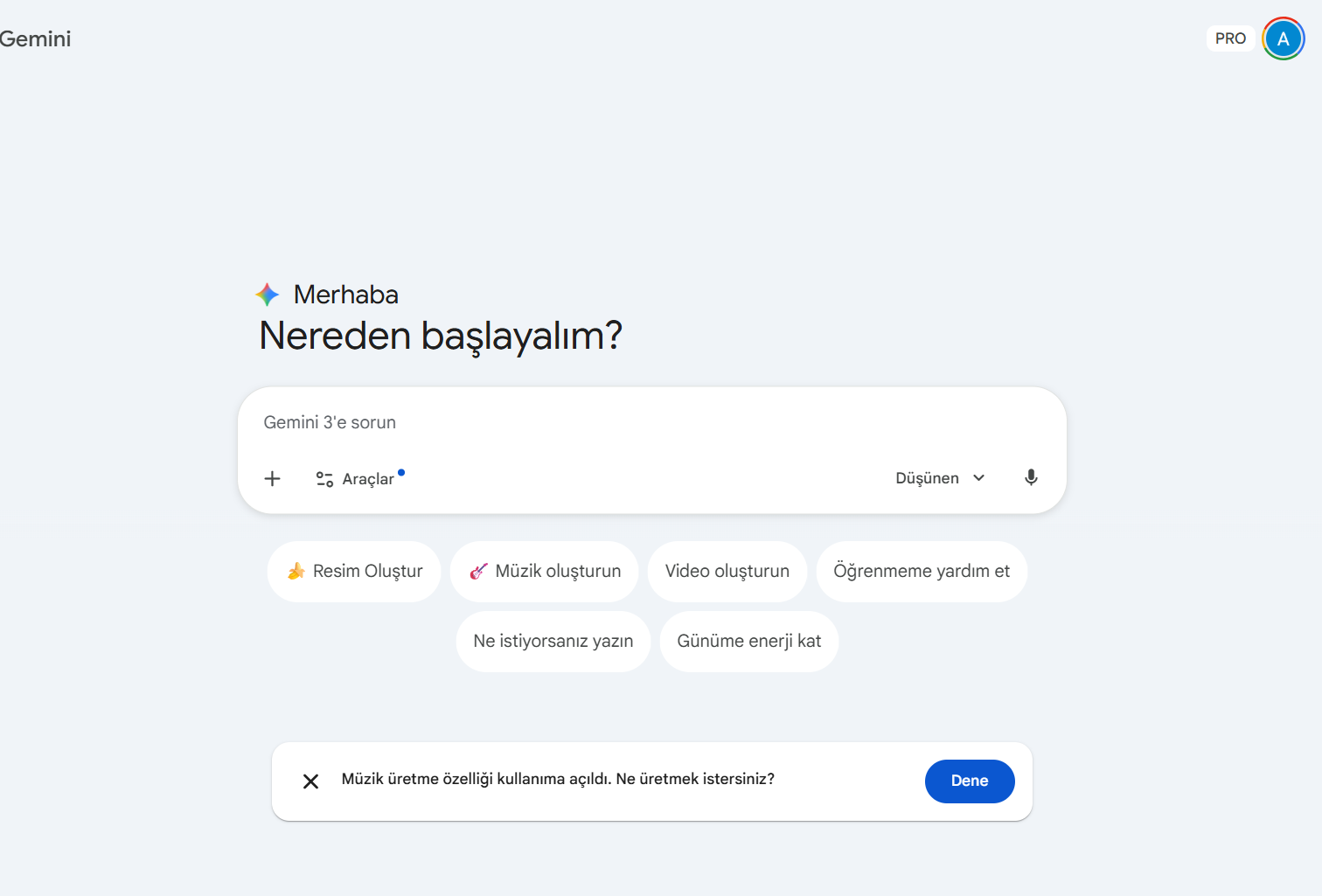
Basic conversational use is straightforward. However, advanced usage involving API integration and prompt engineering requires technical understanding.
Professional Tips
- write precise prompts
- break complex tasks into steps
- request structured outputs
- validate generated information
Micro Details
- response generation usually occurs within seconds
- code outputs are formatted automatically
- multiple answer generation may be available
- structured outputs such as JSON can be requested
🎬 Demo Video
✨ Features
- Çok modlu giriş desteği (metin + görsel)
- Kod üretimi ve hata ayıklama
- Uzun metin özetleme
- Google Workspace entegrasyonu
- SEO uyumlu içerik üretimi
- Veri analizi ve grafik yorumlama
🎯 Use Cases
📸 Screenshots
Reviews
No reviews yet. Be the first!